Skip to content

Trump Invites Modi to Gaza Peace Board: What It Means for India and Global Diplomacy
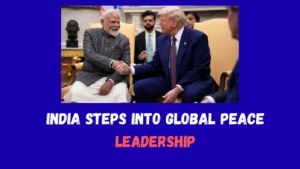
The global political spotlight has once again turned towards India after US President Donald Trump extended an invitation to Prime Minister Narendra Modi to join a proposed international body aimed at peace and reconstruction in Gaza. The move signals a growing expectation that India should play a larger role in resolving global conflicts, not just regional ones.
This development comes at a time when Gaza continues to face humanitarian challenges after prolonged conflict, and global powers are exploring new governance and reconstruction frameworks. India’s possible involvement adds a new dimension to the discussion — one that blends diplomacy, neutrality, and long-term development.
What Is the Gaza “Peace Board”?
The proposed body, informally referred to as a “peace board,” is intended to oversee post-conflict governance, rebuilding, and long-term stability in Gaza. While full operational details are yet to be publicly disclosed, reports indicate that the board would consist of select nations contributing financially, diplomatically, or administratively.
Unlike traditional peacekeeping mechanisms led by the United Nations, this initiative appears to be a US-led diplomatic framework, involving a limited group of countries rather than a broad multilateral setup.
This is where the headline becomes significant: Trump invites Modi to Gaza peace board, placing India among a shortlist of countries considered capable of contributing constructively to such a sensitive region.
Why India’s Invitation Matters
India’s invitation is not symbolic. It reflects how New Delhi is increasingly viewed as a credible global actor with balanced relations across competing blocs.
India maintains:
-
Strong ties with Israel
-
Historical support for Palestine
-
Strategic relations with the US
-
Working partnerships across the Middle East
When Trump invites Modi to Gaza peace board, it signals trust in India’s ability to navigate complex diplomatic terrain without being seen as biased.
India’s Diplomatic Track Record in Conflict Zones

India has consistently supported peace and humanitarian assistance without direct military involvement in most overseas conflicts.
Key Examples:
-
Long-standing participation in UN peacekeeping missions
-
Humanitarian aid to Gaza in previous conflicts
-
Reconstruction support in Afghanistan and Africa
This history strengthens India’s position as a neutral stabilising force, which is likely why Trump invites Modi to Gaza peace board rather than restricting the initiative to Western allies.
How This Impacts India’s Foreign Policy
India’s foreign policy has shifted from being reactive to strategically selective. Joining such a board would not be about power projection, but about influence.
If India accepts:
-
It gains a voice in post-war governance decisions
-
It strengthens ties with both Arab nations and Western powers
-
It reinforces India’s image as a responsible global stakeholder
However, participation also brings responsibility. Gaza is politically sensitive, and any misstep could affect India’s carefully balanced Middle East relations.
Possible Structure of the Peace Board (What We Know So Far)
Based on available reports and global diplomatic norms, the proposed peace board may include:
| Aspect | Expected Role |
|---|---|
| Governance | Oversight of civilian administration |
| Funding | Contributions for rebuilding infrastructure |
| Security | Coordination, not direct military control |
| Aid | Distribution of humanitarian assistance |
| Policy | Long-term stability planning |
This is not a peacekeeping force, but a post-conflict management body.
Global Reactions and Concerns
While some countries have welcomed the idea of a new governance framework for Gaza, others have raised questions.
Key Concerns:
-
Overlap with United Nations responsibilities
-
Acceptance by local Palestinian authorities
-
Long-term legitimacy of a US-led body
Despite this, Trump invites Modi to Gaza peace board knowing that India’s participation could lend the initiative additional credibility among developing nations.
India’s Official Response So Far
As of now, the Indian government has not issued a formal public statement confirming acceptance or rejection of the invitation. This silence is typical in sensitive diplomatic matters.
India usually evaluates:
-
Legal implications
-
Political consequences
-
Alignment with national interest
Only after internal consultation does New Delhi make such decisions public.
Why This Matters for Gaza
For Gaza, the involvement of countries like India could mean:
-
Less politicised aid delivery
-
Greater focus on infrastructure and civilian needs
-
A development-oriented approach rather than purely security-focused oversight
India’s experience in large-scale public infrastructure and welfare delivery could be relevant in post-conflict reconstruction.
Strategic Risks for India
Participation is not without risk.
Possible Challenges:
-
Being caught between rival regional interests
-
Criticism from domestic political groups
-
Managing expectations without direct control
This is why the decision requires careful calibration. Even though Trump invites Modi to Gaza peace board, India will likely negotiate terms before committing.
How This Fits Into India–US Relations
The invitation also reflects evolving India–US ties. While the relationship has had ups and downs, cooperation on global issues has increased.
This move:
-
Reinforces strategic trust
-
Signals deeper political engagement
-
Expands cooperation beyond trade and defence
It also shows that Washington increasingly sees India as a partner in global governance, not just a regional power.
Comparison: Traditional UN Model vs Proposed Peace Board
| Feature | UN-Led Model | Proposed Peace Board |
|---|---|---|
| Leadership | Multilateral | US-led |
| Decision Speed | Slower | Faster |
| Membership | Broad | Selective |
| Funding | Shared | Contribution-based |
| Political Influence | Distributed | Concentrated |
India’s participation could help balance some of these differences.
What Happens Next?
The next steps are likely to include:
-
Diplomatic consultations between India and the US
-
Discussions with regional partners
-
Clarification on funding and governance roles
Only after this process will India decide its level of involvement.
India’s Long-Term Strategic Opportunity in Peace Diplomacy
Beyond immediate headlines, this development fits into a larger pattern of India positioning itself as a problem-solver rather than a power-broker. Unlike countries that rely on military presence or sanctions, India’s influence often comes from development assistance, institution-building, and neutral engagement.
If India chooses to engage with the Gaza peace initiative in any form, it could leverage its experience in:
-
Building civilian infrastructure at scale
-
Running large welfare and food distribution systems
-
Supporting education and healthcare delivery in difficult environments
These strengths are particularly relevant in post-conflict regions where restoring normal life matters as much as political agreements.
Another key factor is credibility. India is often viewed as a country that understands the challenges of developing societies without imposing external models. This perception can help in regions where trust in Western-led initiatives has weakened over time.
However, India is also likely to proceed cautiously. Any engagement would need to align with its long-standing support for a two-state solution and respect for international law. Domestic opinion, regional partnerships, and global diplomatic balance will all play a role in shaping India’s final stance.
In the long run, even limited participation could enhance India’s standing as a responsible global stakeholder—one that contributes to stability without seeking control.
Final Analysis
When Trump invites Modi to Gaza peace board, it highlights a clear shift in global diplomacy. India is no longer just a participant in international forums; it is increasingly being asked to help shape outcomes.
Whether India accepts the invitation or chooses a limited role, the message is clear: New Delhi’s influence now extends far beyond South Asia.
This moment reflects how global powers see India — not as a bystander, but as a stabilising force capable of contributing to peace in some of the world’s most complex regions.read more